Business Case for Video Commerce – D2C Brands
Thesis
Video commerce is the perfect conduit to bridge the gap from where we are today in eCommerce – static images and text – towards a more dynamic future that incorporates multiple experiential layers in a seamless experience.
Key claims
- Fundamentally, D2C eCommerce is a margin business
- The first benefit of video commerce for D2C brands is the ability to increase contribution margins.
- Video commerce is videos that sit natively on the brand’s own website and scale out towards specific channels, then pull the consumer back onto the brand’s website for the transaction.
- The genesis of the hypergrowth phase of live shopping in Western markets will similarly – in all probability – be tied towards video distribution across new media platforms in some way shape or form.
- Major retailers are now making money from selling the inventory of advertising on their website, as part of a retail media network model
We are on the cusp of another major market shift for D2C brands, and their retail counterparts.
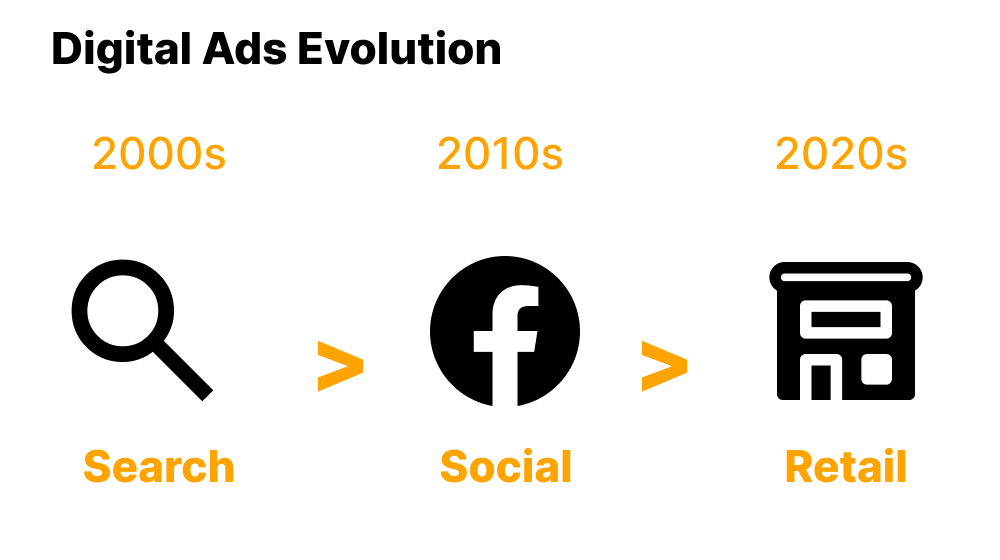
Born a couple decades ago on the backs of eBay, Amazon, Shopify and others, the eCommerce industry has exploded into a multi-trillion dollar behemoth.
But the actual eCommerce experience has changed very little in that time period, despite the advent of tectonic shifts in media (social media), distribution (streaming), computing power (GPUs), and other major tech trends.
The eCommerce experience needs a jolt; the future is less about the channel or the specific strategy, and more about the experience and the blending of physical and digital worlds in that experience.
Video Commerce is the Conduit to the Future
Video commerce is the perfect conduit to bridge the gap from where we are today in eCommerce – static images and text – towards a more dynamic future that incorporates multiple experiential layers in a seamless experience.
Before we get into the what, why, and how of the above, let’s take a basic look at the core habits of consumers around social + video:
- People spend an average of 2.5 hours a day on social media – the dopamine hit is addictive, and video content is the primary driver of that dopamine loop
- 78% of consumers say they feel more confident with a purchase after viewing user-generated content like reviews and testimonials
- 68% of consumers say they prefer learning about products through videos
By incorporating video, brands can hold customers’ attention longer, transforming product pages into dynamic spaces where shoppers want to spend time.
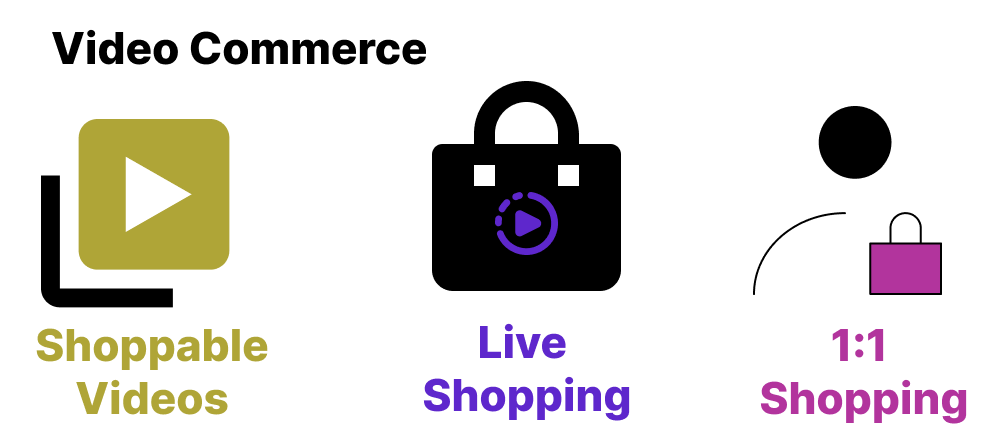
Within video commerce we have three key elements:
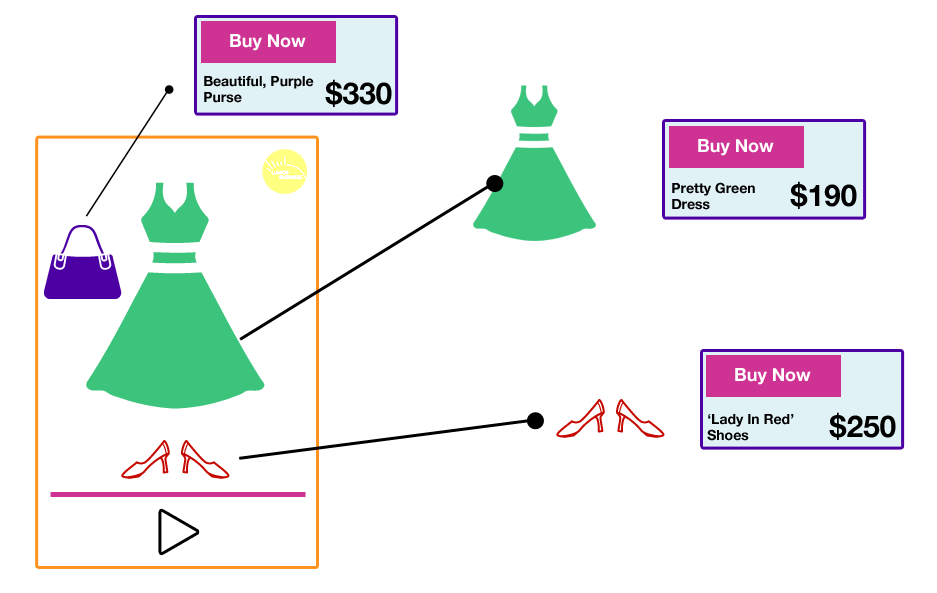
- Shoppable Video – shorter clips of content delivered in a frame or carousel, where consumers can shop directly in the video frame
- Live Shopping – longer pieces of content that can be pre-recorded or run with live hosts, where shopping can be done in real-time from the video frame
- 1:1 Shopping – whereby brands can connect shoppers directly to one of their staff, virtually, for the purpose of a more personal shopping experience
All three of the above leverage video commerce in one form or the other, but the sequence of where to start will be explored further below; not all are created equal, nor resonate with consumers in the early days.
What is the Business Case for Video Commerce for D2C Brands?
Before diving into the details, let’s step back and look at the why from a business perspective for any brand that incorporates eCommerce into the core of their business model.
We know there are multiple different metrics to slice through when looking at the D2C business model, from LTV/CLV (Customer Lifetime Value), to CAC (Customer Acquisition Costs), to Retention (Returning Customers), and down the line towards Conversion, AOV, etc.

A lot of this can be captured with ‘Unit Economics,’ which ultimately leads to margins. Fundamentally, D2C eCommerce is a margin business:
- Fat margins – such as those in the luxury industry – means that a brand needs less customers to turn a profit, but must work harder to earn and retain those customers
- Thin margins – such as those in fast fashion – means that a brand needs a high volume of customers, and must work to retain some cohort of customers to maintain margins
Many D2C brands operate somewhere in the middle, which means that any incremental gains in gross margin can have a big impact on their overall business, whether from the lens of customer acquisition, loyalty, or retention.
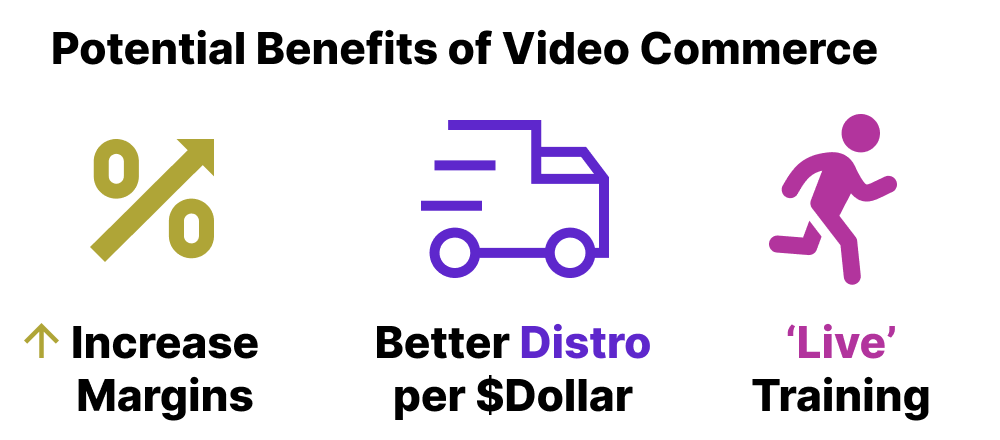
Let’s look at three potential benefits from a macro business perspective:
- Increase Margins
- Better Distribution per Dollar Spent
- Training for the Live Commerce Marathon
Potential Benefit #1 – Increase Margins
The first benefit of video commerce for D2C brands is the ability to increase contribution margins. Why? Better conversion rates per customer, less need for discounting, better targeting ability = lower CAC (customer acquisition costs).
Ultimately, video commerce is being hosted on a brand’s own website. Channels like email, social, and programmatic may be used for distribution, but the transaction occurs on the brand’s website itself; unlike social commerce, for example.
We can pull in a few assumptions through an analysis of multiple video commerce case studies in order to put together the logic on gross margin:
- Increased Conversion Rates: 3X boost and up to 10X compared to static landing pages
- Increased Engagement: multi-X boost compared to static content
- Increased Retention: 300% repeat purchase rate
(data via Firework)
The basic expectation is that the average viewer passing through a page where video commerce exists – let’s say a popular PDP (Product Description Page) – will spend more time on a video (vs. a set of static images) and be roughly 3X more likely to convert.
If we add to the that the opportunity to use specific types of video content to increase expected satisfaction with the product (UGC Reviews), decrease likelihood of returns (Staff Tutorials), and pair it with expert insights (Expert-Generated Content), we can make a few simple observations:
- More people engage per page scroll – compared to the static experience
- More people buy per video click – compared to the static page experience
- More brand trust is built in the purchase and post-purchase state – compared to current methods
Thus, the need to promote via expensive marketing, offer discounts to clear inventory, and generally “makes waves” just to sell the product are reduced, and potentially dramatically.
If all this proves to be true, each unit sold will generate more in contribution margin for the corresponding business.
The tech to make this happen is shoppable video.
Potential Benefit #2 – Better Distribution Per Dollar Spent
Say that we take the above to be true – several PDPs for top products and Category pages are now equipped with a set of (shoppable) videos that resonate with certain consumer audiences.
It’s natural that the next step would be distribution of those assets towards preferred channels, whether email, social, or programmatic.
Yes, we already see branded videos performing well on social, but we aren’t talking about ‘social commerce‘ here were the transaction takes place on a 3rd-party social platform like TikTok Shop or WhatNot.
Video commerce is videos that sit natively on the brand’s own website and scale out towards specific channels, then pull the consumer back onto the brand’s website for the transaction.
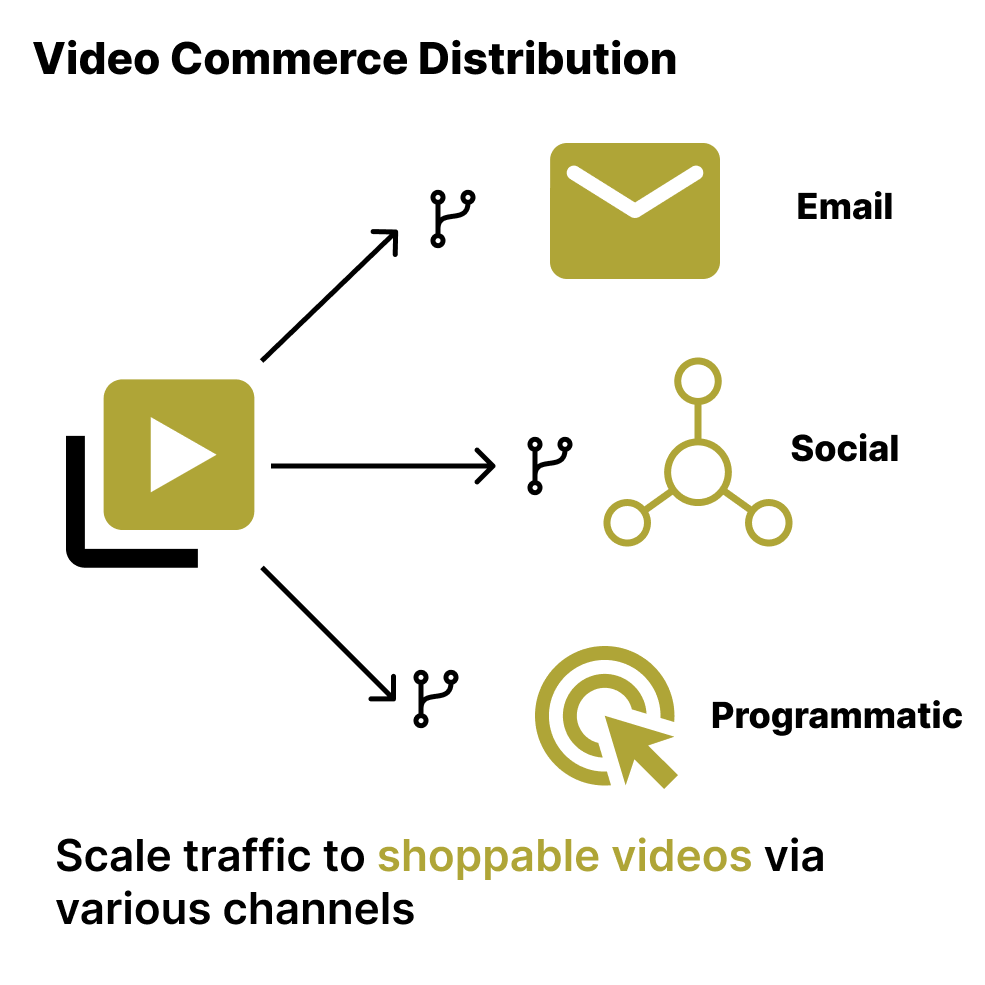
Video Commerce assets can scale outwards to these channels, which means that as we assume in the above, video will perform better than standard images or text:
- Emails can have video thumbnails to drive personalization narratives, or build excitement about new product launches
- Social can integrate video assets to mimic social commerce experiences, yet seamlessly pull the consumer back to the website so they don’t have to enter 3rd party payment information
- Programmatic can tap into the future of the ‘premium internet,’ where brands can scale their top video commerce assets across partner platforms and other retail media
The dollars spent on this type of distribution will likely be better spent from both a performance marketing and brand marketing perspective. ROAS (Return on Average Spend) is one way to classify this, but for some brands it may be bigger picture than that.
Each brand will have its own strategies in this regard, but regardless, the rich nature of video commerce means that it can work across multiple prongs of a brand’s marketing strategy.
The tech to make this happen is shoppable video integration with partner platforms.
Potential Benefit #3 – Training for the ‘Live Commerce’ Marathon
Many have now seen the stories and anecdotes from China where billions ($1.7 Billion!) of dollars of lipstick were sold in a few hours of a live shopping stream – and then wonder why it has not yet happened in the West.
There are several structural reasons why it hasn’t happened – from the types of goods more typically sold online in the Chinese economy, to the different consumer practices around eCommerce – but that doesn’t change the expectation that it will, one day, happen in a similar way.
The QVC/HSN era blossomed in the US market starting in the 80s, and generated billions of dollars of revenue for brands, investors, and mom & pop shops alike. Why?

Well, beyond the dawn of a new phenomenon – live shopping – it was also driven by the acquisition of new distribution channels for selling goods direct-to-consumer. In that case it was cable tv networks.
The genesis of the hypergrowth phase of live shopping in Western markets will similarly – in all probability – be tied towards video distribution across new media platforms in some way shape or form.
But brands need to start somewhere. Going from ‘zero to live’ is both an expensive and daunting proposition; but getting up and running on shoppable video, testing different distribution strategies, and ultimately seeding the live-content creation process is a great first step.
The tech to make this happen is shoppable livestream videos, embedded in publisher platforms and social feeds.
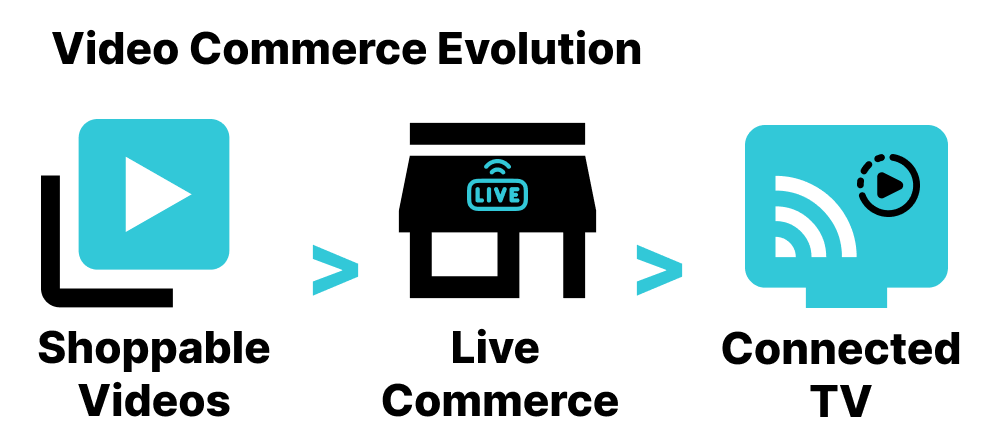
Shoppable Video > Live Commerce > Connected TV
In many ways, shoppable video is the trojan horse for live shopping, whereby the average brand starts with that solution and gradually expands into live shopping or live commerce as they become more comfortable.
The ‘tv networks’ in this era are likely the streaming networks, publishers, and retail media networks, who together will comprise what they are calling the ‘premium internet‘ from an advertising perspective. This means this same content that starts on a brand’s website as shoppable videos, may soon enough appear as an ad on Connected TV.
For the question “what will be the next frontier of retail media,” a 2023 survey by the Path to Purchase Institute among advertisers revealed “shoppable video content” as the most popular selection, ahead of “increased personalization” and “omnichannel audience tracking.”
Exciting new formats, like shoppable video, will bring richer experiences to consumers with the same targeting and closed-loop measurement as onsite retail media.
By the time it reaches the end consumer, at scale, it may be difficult to differentiate content from advertising, but the distinguishing feature will be its shoppability. Whether via Connected TV, premium video display ads, or better social feeds, there will be many possible ways for brands to use video to their advantage in the future to scale to new audiences.
HSN/QVC “2.0” may be a blend of these technologies, delivered as streaming content on publisher platforms as live content.
In the interim, shoppable video remains as the training ground. Much work is to be done to get the basics of video commerce up and running; as they commonly say, it’s a marathon not a sprint.
The technology to make this happen is a combination retail media networks, connected tv partners, and livestream shoppable video.
Pulling the Pieces Together – Market Share
There is certainly some conjecture in the above, and multiple hypothesis to be tested, but fortune – as they say – favors the bold.
Many brands are already experimenting with various levers of the technology, and throughout history we have seen many brands fortune’s balloon when they nailed their live shopping strategy. Spanx is but one relatively modern example.
She (Blakely) once had to muster the courage to hawk her wares 6 to 12 times a month on home shopping channel QVC.
Forbes – How Sara Blakely of Spanx Turned $5,000 into $1 billion
And when, in 2002, Sara appeared on shopping channel QVC with her second product, the mid-thigh Power Panties, she sold 8,000 pairs in just six minutes
For the bold – the early adopters – major segment and category shifts in market share are expected in the future.
This isn’t by any means a ‘startup’ market either; billion dollar luxury incumbents across beauty, fashion, and hard goods will need to figure this out sooner rather than later.
Market share shifts are not born overnight and there is enough body of evidence to safely assume that when a market player figures out the video commerce playbook, they will be able to leverage it in multiple facets to increase their market share.
Wholesale Partners and The Dawn of Connected Commerce
To finish this post off, we tie in the expected lift from expansion of the technology into the retailer ecosystem, where many D2C brands are tied into as part of the wholesaling arm of their business. This model is being branded as connected commerce.
Major retailers are now making money from selling the inventory of advertising on their website, as part of a retail media network model. From giants such as Walmart, to luxury department stores such as Saks, to many in between.
Video commerce is likely to tie into this model in the future, as shoppable video ties directly into the future of advertising for a range of possible publishers.
Retail media is a slightly different model, where sometimes retailers prefer a more partnership-oriented approach, allocating their inventory to ‘brand partners’ as opposed to advertisers as a whole.
The upshot in this model is that the same experience above expands onto retailers own sites in the future, and potentially into their own physical stores (should they own any).
From the omnichannel approach of a native D2C brand, to the phygital (physical-digital) footprint of retailers, shoppable video and video commerce can be used can transcend the boundaries of typical online shopping, creating a more human experience for customers and driving numerous top and bottom line benefits for all parties involved.